
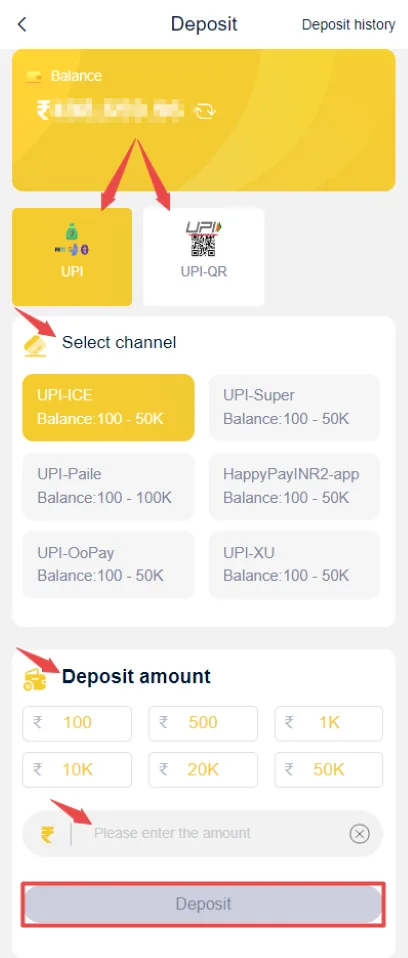
Confirm whether the payment actually completed
Check your bank or UPI history. A failed or reversed payment should not be treated the same as a successful debit.
Keep the reference
Record the transaction ID, amount and time. Those details are more useful than a cropped balance screenshot.
Check in-app deposit history
Look for pending, processing, failed or successful status before attempting a second payment.
Escalate safely
Use the service route and provide the payment reference. Never provide a PIN or OTP.
Bank success, platform credit and final balance are separate checkpoints
A bank/UPI success message proves the payment left or was accepted by the payment channel; it does not prove the wallet was already matched. Keep the UTR until the platform history confirms the credit.
Do not send a second payment to test the first
A duplicate transaction creates two references and can make the case harder to follow. Wait for the first status or contact service with the original reference.
Mask personal data in evidence
When sending a transaction screenshot, keep the reference, time and amount visible while hiding unrelated account balances and secret information.
What the bank record should show
Confirm the payment was successful rather than pending or reversed. Record the UTR, amount and time.
What the IN999 record should show
Check deposit/transaction history for the corresponding amount and status. If there is no match, keep the banking reference for support.
Why duplicate payments make recovery harder
Two equal payments can be confused without separate references. Wait for the first status before retrying.
Pending deposit: match three records
A useful deposit investigation compares the payment-app record, the bank/UPI reference and the IN999 wallet history. If the payment app says successful but the wallet has no matching credit, the UTR/reference becomes the key evidence.
Do not create duplicate evidence by paying again
Sending the same amount repeatedly can create multiple references and make the case harder to reconcile. Wait for the existing transaction status or use support with the original reference before repeating a payment.
Deposit escalation checklist
- Amount and time
- UTR/transaction reference
- Masked payer identity
- IN999 wallet status
- Screenshot with secrets removed
IN999 deposit pending: compare bank state with wallet state
There are two timelines: the bank or UPI timeline and the IN999 wallet timeline. A debit can exist before the wallet credit. Keep the UTR/reference and time so those two records can be matched instead of assuming the money disappeared.
What to do before making a second deposit
Check whether the first transaction is still pending, failed or reversed. A second payment can create two separate unresolved references and make the support case more complicated.
Deposit credited with a different amount
Compare the wallet credit with the original payment amount and any visible transaction entry. Preserve both records before opening a case. Do not edit screenshots or combine unrelated payments into one image.
UPI reference, order status and wallet status should tell one consistent story
For a UPI deposit, the bank or UPI app can show success while the wallet is still waiting for confirmation. Keep the UTR/reference exactly as shown. If the deposit screen also displays an order number, preserve both because one may identify the payment side and the other the wallet order.
QR payment does not mean every new QR belongs to the same order
If a deposit flow generates a QR or payment instruction for one order, avoid reusing an old screenshot for a later amount. Start from the active deposit flow, confirm the amount and pay only once for that order. Reusing stale payment instructions can make matching the reference harder.
Pending, failed and reversed are different outcomes
Pending means the transaction has not reached a final state. Failed means the attempt did not complete. Reversed means a debit returned to the source account. Record which state appears on both the payment side and the wallet side before deciding whether another deposit is necessary.
When the reference is missing from one side
If the bank shows a debit but the wallet history has no matching order, preserve the bank reference and time before reopening the deposit flow. If the wallet shows an order but the payment app has no success record, do not describe it as a completed payment. Keep the two records separate until they can be matched.
If support asks for evidence, share only the transaction details needed for the case and mask unrelated account information.
IN999 deposit pending decision tree
Keep the UTR/reference, amount and time.
Do not assume a deposit was completed.
Track each payment reference separately.
Compare the final bank and wallet records before trying again.
Deposit evidence pack
For a persistent pending deposit, preserve the UTR/reference, amount, time, selected payment method and the wallet state. Mask unrelated account information if a screenshot is shared with support.
Final deposit check after the status changes
When the deposit leaves pending status, compare the wallet credit with the original payment amount and keep the final transaction record. If the bank and wallet disagree, preserve both states before opening another payment attempt.
Frequently asked questions
Should I create a new account to fix this?
Usually no. Fix the existing account or transaction problem first.
Should I share an OTP with someone helping me?
No. Keep OTPs, passwords and payment PINs private.
Where should I check the current status?
Use the relevant in-app history or account/service area when available.
Can I submit another IN999 deposit while the first one is pending?
It is safer to understand the first transaction state before repeating the payment, especially when the bank already shows a debit.
What is the most useful deposit detail to keep?
The UTR or transaction reference, together with amount and time, is the strongest link between the payment record and wallet status.
What if the bank reverses the payment?
If the debit reverses and the wallet was not credited, keep the reversal record and avoid treating the transaction as a successful deposit.